Zoho Books (Free / Standard) review 2027
A full-featured accounting suite with a free tier for small businesses, inventory and projects on the mid plans, and the whole Zoho ecosystem behind it

Is the Zoho Books Worth It?
Most features for the money. Zoho Books gives a small business more features per dollar than anything here, and its free tier includes bank feeds that Wave now charges for. It is less known to accountants, which can matter at year end.
Zoho Books Pros & Cons
- Free plan with bank feeds for businesses under $50,000
- Inventory, projects and multi-currency on Professional for $50
- Zoho CRM, Inventory and Payroll integrate natively
- Client portal and recurring invoices
- Auto-matching trailed QuickBooks and Xero
- US payroll is limited to some states
- Fewer accountants use it
What problem does Zoho Books solve for a small business on a budget?
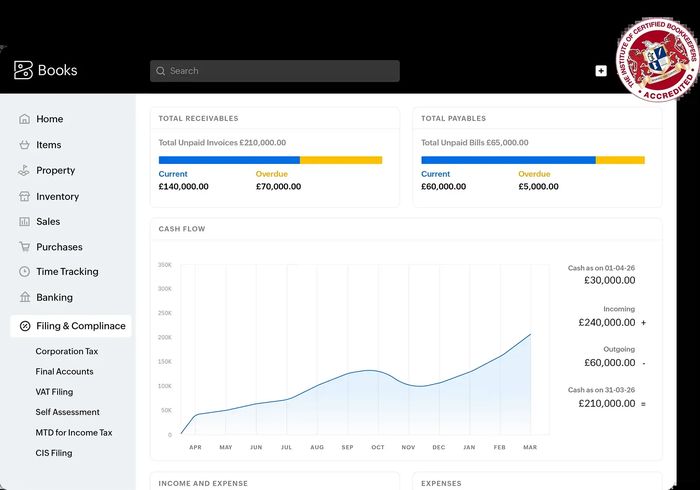
Zoho Books is a full-featured accounting suite with a free tier for small businesses, inventory and projects on the mid plans, and the whole Zoho ecosystem behind it. The problem it addresses is the price ladder: most accounting software makes you pay before you can connect a bank feed, and the free tiers elsewhere stop at manual import. Zoho Books includes bank feeds on the free plan for businesses under $50,000 in revenue, so a one-owner business can reconcile against real transactions without a subscription. The verdict headline is "Most features for the money," and the tested strengths back that up: inventory, projects and multi-currency arrive on Professional for $50, Zoho CRM, Inventory and Payroll integrate natively, and there is a client portal plus recurring invoices. It is less known to accountants, which can matter at year end.
How did Zoho Books score in our testing?
We scored it across five criteria for a total of 8.2 out of 10.
- Bookkeeping core: 24 out of 30. This measures bank feeds and matching, categorisation rules, reconciliation, and double-entry integrity on our three-month data set. It was the weakest area relative to the leaders.
- Invoicing & payments: 16 out of 20. This covers invoice templates, recurring billing, online payment fees, reminders, and time and expense billing.
- Reporting & tax: 13 out of 15. This covers P&L, balance sheet, cash flow, sales-tax tracking, 1099 and year-end exports.
- Integrations & accountant access: 12 out of 15. This covers the app marketplace, payroll, inventory, and whether an accountant can work in it free.
- Value: 17 out of 20. This measures the monthly price for a one-owner business with invoicing and bank feeds, at renewal.
Where does Zoho Books stand out?
The free plan carries bank feeds for businesses under $50,000, which is the single most useful fact for a budget-conscious owner. Inventory, projects and multi-currency sit on Professional for $50. Zoho CRM, Inventory and Payroll integrate natively, and the client portal and recurring invoices are included. In our measured test, reconciling 400 transactions took 70 minutes, and the entry plan measured at $0/mo. Card fees run at processor rates through Stripe or PayPal.
How does the technology behind Zoho Books work?
Bank feeds pull transaction data from your bank into the ledger, where categorisation rules assign accounts and reconciliation matches statement lines against recorded entries. Double-entry bookkeeping keeps every transaction balanced across at least two accounts, so the reports derive from the same ledger rather than separate records. Sales-tax tracking and VAT filing work from those recorded transactions, and the VAT return can be filed to HMRC from inside the product. Zoho Payroll runs as a connected module for select states, and the app marketplace links other services into the same data.
What do you get on each Zoho Books plan?
The price row reads: free under $50k revenue; Standard $20/mo; Professional $50. There is a free plan, with one user on Free and three on Standard. Bank feeds are included. Card payments run via Stripe/PayPal. Payroll is Zoho Payroll, limited to select states. Inventory sits on the Professional tier. An accountant user can work in the file, and the mobile app covers iOS and Android.
How does Zoho Books compare with QuickBooks Online, Xero and Wave?
QuickBooks Online scored 8.5 at $35, with no free plan, one user on Simple Start, the best auto-matching in our test, a 2.99% card and 1% ACH fee, QuickBooks Payroll from $50/mo plus $6 per employee, inventory on the Plus tier, a free accountant user, and iOS and Android apps. It is ahead on bookkeeping speed and accountant familiarity; Zoho Books is ahead on entry price and on including bank feeds for free.
Xero scored 8.5 at $20, with no free plan, unlimited users on all plans, bank feeds with rules, card payments via Stripe/GoCardless at 2.9% + 30¢, Gusto payroll integration, basic inventory on all plans, free advisor access, and iOS and Android apps. It matches Zoho Books on score and beats it on unlimited users and accountant acceptance; Zoho Books counters with a free tier and inventory on Professional.
Wave scored 7.6, with a free Starter plan and Pro at $16/mo, unlimited users, bank feeds only on Pro, card fees of 2.9% + 60¢ on Starter and 2.9% + 30¢ on Pro, Wave Payroll from $20/mo plus $6 per employee, no inventory, collaborator access, and iOS and Android apps. Wave is cheaper at the paid tier but charges for the bank feeds Zoho Books gives away.
| Zoho Books | QuickBooks Online | Xero | Wave | |
|---|---|---|---|---|
| Our score | 8.2 | 8.5 | 8.5 | 7.6 |
| Price | Free under $50k revenue; Standard $20/mo; Professional $50 | Simple Start $35/mo; Essentials $65; Plus $99; frequent 50% intro offers | Early $20/mo; Growing $47; Established $80 | Starter free; Pro $16/mo |
| Free plan | Yes | No (30-day trial) | No (30-day trial) | Yes |
| Users on entry plan | 1 (Free), 3 (Standard) | 1 (Simple Start) | Unlimited on all plans | Unlimited |
| Bank feeds | Yes | Yes, best auto-matching | Yes, with rules | Pro plan (manual import on Starter) |
| Card payment fee | Via Stripe/PayPal | 2.99% card, 1% ACH | Via Stripe/GoCardless (2.9% + 30¢) | 2.9% + 60¢ (Starter), 2.9% + 30¢ (Pro) |
| Payroll | Zoho Payroll (select states) | QuickBooks Payroll add-on from $50/mo + $6/employee | Gusto integration | Wave Payroll add-on from $20/mo + $6/employee |
| Inventory | Professional tier | Plus tier | Basic on all plans | No |
| Accountant access | Accountant user | Free accountant user | Free advisor access | Collaborator access |
Where does Zoho Books fall short?
It lost on bookkeeping speed and accountant familiarity. Auto-matching trailed QuickBooks and Xero in our test. US payroll is limited to some states. Fewer accountants use it, which can slow down year-end work if your accountant expects a different platform.
Is Zoho Books good value?
The price summary is free, with Standard at $20/mo. Our measured entry plan came in at $0/mo, and card fees are processor rates rather than a markup. Against QuickBooks Online at $35, Xero at $20, FreshBooks at $21, Wave at free with Pro at $16/mo, and Sage Accounting at $10, Zoho Books sits at the free end while still including bank feeds, inventory on Professional, and native Zoho integrations.
Who should buy Zoho Books?
It is still right for product businesses on a budget, and Zoho users. If you already run Zoho CRM or Zoho Inventory, the native connections keep your records in one place, and the free tier covers a business under $50,000 in revenue without a subscription. If your accountant insists on QuickBooks or Xero, that preference is the reason to look elsewhere.
Zoho Books at a Glance
Rubric v1: Bookkeeping core 30 · Invoicing & payments 20 · Reporting & tax 15 · Integrations & accountant access 15 · Value 20. Score = Σ ÷ 10, locked Sep 11, 2026. How we rank.
Where to buy — prices checked Sep 11, 2026
Zoho Books specifications
Where it loses
Bookkeeping speed; accountant familiarity.
Still the right pick for
Product businesses on a budget, and Zoho users.
What owners say
No reader ratings yet. This block fills in from real submissions only — we never write, buy or generate reader reviews, and none of them touch the editor score.
Every submission is read by a person before it appears. Reader opinion is published separately and never changes our score.